Serving Lewisville and the surrounding DFW area Call (469) 702-8764
Residential Service

Garage Floor Epoxy Coating in Lewisville, TX

Epoxy is still the most common garage floor coating in North Texas, and for good reason. It's durable, affordable, and looks great when the concrete underneath is prepped right. Here's what actually goes into a residential epoxy job that lasts.

Last reviewed July 2026.
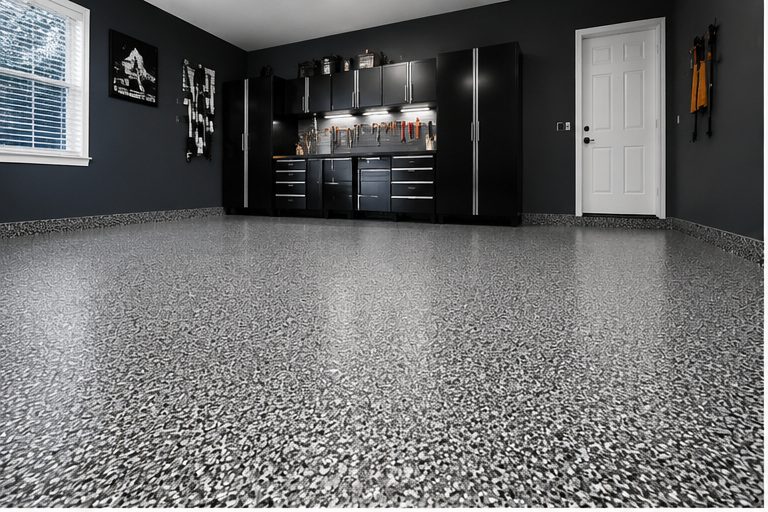
Empty space with a polished, seamless epoxy coated concrete floor
Representative photo. A properly ground and coated floor has no visible seams or pooling.

Quick Answer

Best For
Residential garages, budget-conscious projects
Lasts
10 to 15 years with proper concrete prep
Install Time
1 to 2 days
Vehicle Ready
3 to 5 days
Maintenance
Sweep regularly, mop with pH-neutral cleaner
Typical Cost
$4 to $10 per square foot depending on style

Quick Answer

  • Solid, flake, and metallic epoxy are the three main residential garage floor styles.
  • Standard epoxy typically needs 3 to 5 days to fully cure before heavy vehicle traffic.
  • Epoxy can yellow in direct UV exposure over time; a UV-stable topcoat helps reduce this.
  • Cost usually runs $4 to $7 per square foot for a straightforward residential garage.
  • Prep work (grinding and moisture testing) determines how long the coating actually lasts, more than the epoxy product itself.

If you're comparing epoxy to polyaspartic for your Lewisville garage, see our polyaspartic coating page for a direct comparison. This page focuses specifically on epoxy: the styles available, how it's installed, and what to expect.

What Are the Different Types of Garage Floor Epoxy?

Solid Color Epoxy

A single, uniform color across the floor. It's the simplest and most affordable option, and it holds up well for garages used mainly for parking and storage.

Flake Epoxy

Decorative color flakes are broadcast into the wet base coat, creating a speckled, terrazzo-like look. Flake systems also add texture, which helps with slip resistance when the floor gets wet.

Metallic Epoxy

Metallic pigments create a marbled, three-dimensional look with depth and movement. It's the most visually striking option and typically costs more due to the skill required to apply it evenly.

How Is Garage Floor Epoxy Installed?

  1. Moisture Test

    We check the slab's moisture level using a calcium chloride test (ASTM F1869) or an in-situ relative humidity probe (ASTM F2170) before quoting, since a high reading means a moisture-mitigating primer is needed first.

  2. Diamond Grinding

    The concrete surface is mechanically ground to remove old sealers, oil staining, and the top cream layer, opening it up for the epoxy to actually bond.

  3. Crack Repair

    Any cracks are routed and filled so they don't telegraph back through the new coating within the first year.

  4. Base Coat

    The primary epoxy layer goes down. If you're doing a flake or metallic system, this is when flakes are broadcast or metallic pigments are worked into the wet base.

  5. Topcoat

    A clear, UV-stable topcoat seals everything in and is what actually takes the daily wear from tires, foot traffic, and tools.

  6. Cure Time

    Standard epoxy typically needs 24 hours before light foot traffic and 3 to 5 days before parking a vehicle on it.

What Should You Know Before Choosing Epoxy for a Texas Garage?

UV Exposure Near the Garage Door

Standard epoxy is more prone to yellowing under direct UV exposure than polyaspartic. In a Lewisville garage, this usually shows up first at the door opening, especially on south- or west-facing garages that get direct afternoon sun. A UV-stable topcoat slows this down significantly, but it's worth knowing upfront rather than being surprised by it in year two.

Hot Tire Pickup

When a car's tires have picked up heat from summer pavement and then sit on a standard epoxy floor, the heat and weight can occasionally soften the coating enough to leave marks, especially on older or lower-grade epoxy systems. Higher-quality epoxy systems and proper cure time before use both reduce this risk.

Cure Time Matters More in Summer

Epoxy curing is temperature and humidity sensitive. Installing during a Texas heat wave without adjusting timing can affect how the coating sets. This is part of why the installer's experience with local conditions matters as much as the product itself.

How Much Does Garage Floor Epoxy Cost in Lewisville?

Solid color epoxy typically runs $4 to $6 per square foot installed. Flake systems run slightly higher, usually $5 to $7 per square foot, due to the extra material and labor. Metallic epoxy is the most expensive residential option, often $7 to $10 per square foot, because of the skill and time needed to get the marbled effect right. A standard two-car garage (400 to 500 square feet) typically lands between $1,800 and $3,500 depending on the style chosen.

Frequently Asked Questions

How long does garage floor epoxy last?

A properly prepped and installed epoxy floor typically lasts 10 to 15 years before it needs recoating. Floors that fail earlier almost always trace back to inadequate concrete prep, not the epoxy itself.

Can epoxy be applied over an existing painted or sealed floor?

Not without grinding it off first. Epoxy needs a clean, mechanically profiled surface to bond properly. Coating over existing paint or sealer is one of the most common causes of early peeling.

Is flake or metallic epoxy more slip resistant?

Flake systems generally add more texture and slip resistance than a smooth metallic finish. If slip resistance is a priority, a flake system or a texture additive in the topcoat is worth discussing.

Does epoxy work well for a garage that doubles as a home gym?

Yes, as long as the coating system is rated for the equipment weight and any dropped-weight impact you expect. A flake system tends to hide scuffs better than a solid color in a high-use space like a home gym.

Standards and References

  1. ASTM International, ASTM F1869-22, Standard Test Method for Measuring Moisture Vapor Emission Rate of Concrete Subfloor Using Anhydrous Calcium Chloride
  2. ASTM International, ASTM F2170-19a, Standard Test Method for Determining Relative Humidity in Concrete Floor Slabs Using in situ Probes
  3. International Concrete Repair Institute, Guideline No. 310.2R-2013, Selecting and Specifying Concrete Surface Preparation for Sealers, Coatings, Polymer Overlays, and Concrete Repair

Get a Free Epoxy Quote for Your Lewisville Garage

Tell us about your space and we'll get back to you with pricing, no pressure, no obligation.

Request a Free Quote