Serving Lewisville and the surrounding DFW area Call (469) 702-8764
Lewisville, Texas

Garage Floor Epoxy & Polyaspartic Coating in Lewisville, TX

A garage floor coating is only as good as the concrete underneath it. We test moisture, grind the surface, and fix cracks before any coating goes down, so the floor still looks right in five Texas summers, not just the first one.

1–2 DaysTypical install time
LifetimeWarranty on materials and labor
LocalServing Lewisville and Denton County

Quick Answer

Best For
Residential garages and light commercial spaces
Lasts
10 to 20 years with proper prep
Install Time
1 to 2 days for most residential garages
Vehicle Ready
24 hours (polyaspartic) to 5 days (standard epoxy)
Maintenance
Sweep regularly, mop with pH-neutral cleaner
Typical Cost
$4 to $9 per square foot installed

Quick Answer

  • Polyaspartic coatings resist hot tire pickup and won't yellow in Texas sun; standard epoxy can.
  • Concrete prep (grinding, not acid etching) is what actually determines how long a coating lasts.
  • Most residential garages take 1 to 2 days depending on prep needed and cure time.
  • Cost typically runs $4 to $9 per square foot in the Lewisville area depending on system and prep.
  • A moisture test before coating is the single biggest predictor of whether a floor holds up.

Lewisville sits in Denton County, and the concrete under most garages here was poured on expansive clay soil. That matters more than people think. Clay swells and shrinks with moisture, which puts stress on a slab that a coating either handles or doesn't. This page walks through what actually goes into a floor coating that holds up here, not just a marketing description of the finish.

Last reviewed July 2026.

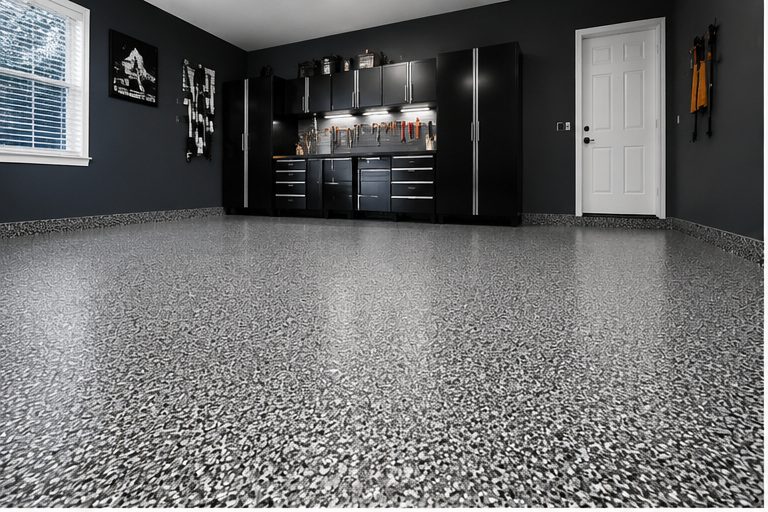
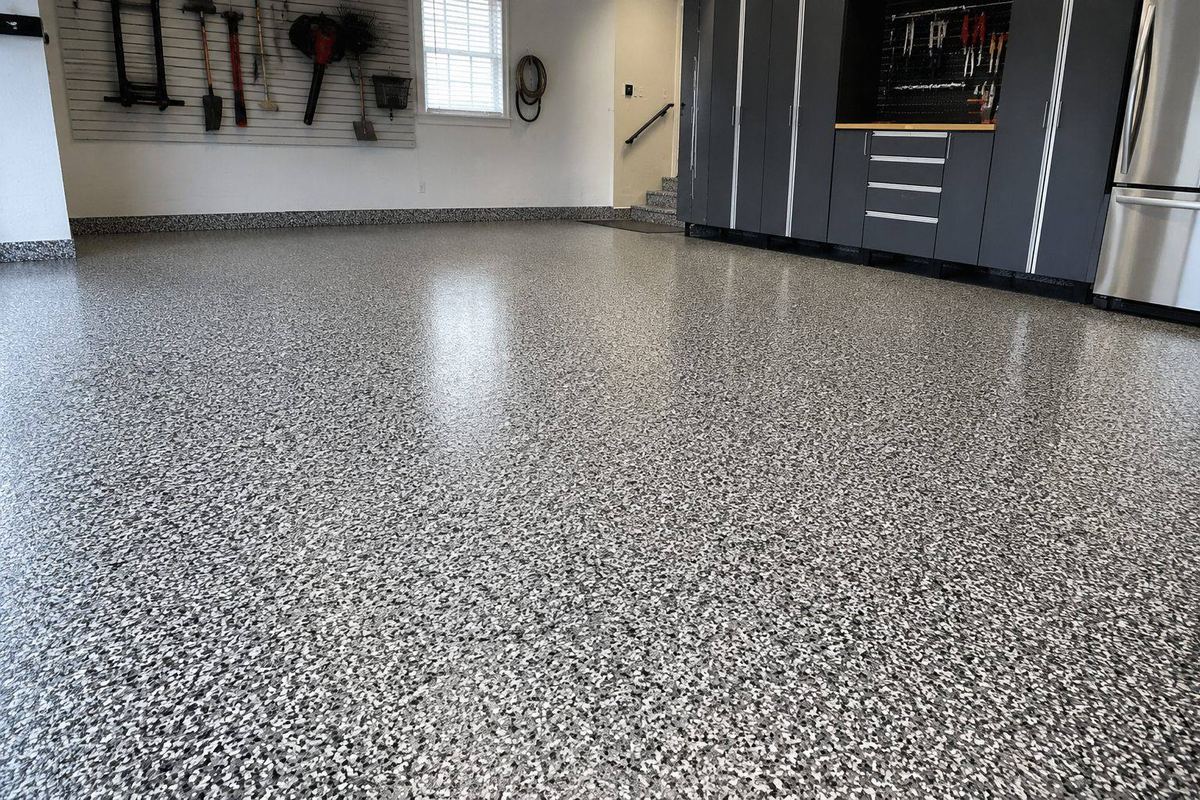
Empty space with a polished, seamless epoxy coated concrete floor
Representative photo. A properly coated floor stays smooth, seamless, and easy to maintain.

Why Does Concrete Prep Matter More Than the Coating Itself?

Most garage floor coatings that fail didn't fail because of a bad product. They failed because the concrete underneath wasn't ready for it. Coating over dust, sealers, or a moisture problem is the single most common reason a floor peels within the first year or two.

Diamond Grinding, Not Acid Etching

A lot of DIY kits and lower-cost crews still use acid etching to prep concrete. It's fast and cheap, but it only opens the surface a little, and it doesn't remove existing sealers, oil staining, or the thin cream layer that forms on top of poured concrete. Diamond grinding with a floor grinder actually profiles the surface at a mechanical level, giving the coating something real to bond to. The industry standard for this is the International Concrete Repair Institute's Guideline 310.2R, which grades concrete surface texture on a scale from CSP 1 (nearly smooth) to CSP 10 (heavily grooved). Most epoxy and polyaspartic garage systems call for a CSP 3 to CSP 5 profile, something acid etching typically can't produce on its own. This is the difference between a floor that lasts 10 to 20 years and one that starts lifting at the edges within 18 months.

Why Moisture Testing Comes First

Concrete is porous, and moisture moves through it from the ground up, especially on a slab poured directly on soil, which is how nearly every garage in Lewisville is built. If moisture vapor is coming up through the slab and a coating goes down anyway, that moisture has nowhere to go. It builds up underneath the coating and eventually pushes it loose, usually showing up as bubbling or delamination. The two standard tests are a calcium chloride test (ASTM F1869) or an in-situ relative humidity probe test (ASTM F2170), and the result tells us whether the slab needs a moisture-mitigating primer first. Skipping this step is one of the most common reasons for early coating failure, and it's invisible until the floor starts failing.

Signs You Can Check Yourself Before Calling Anyone

You don't need a meter to get a rough sense of whether your slab has a moisture problem. Two things are worth looking for on bare concrete before it's ever coated: efflorescence, a white or grayish powdery residue that forms when moisture carries salts up through the concrete and leaves them on the surface as it evaporates, and dark, damp-looking patches that don't dry out even during a stretch of dry weather. Neither one guarantees a problem on its own, and neither replaces an actual moisture test, but if you see either one, it's worth mentioning to whoever quotes the job so they know to test carefully before recommending a system.

Concrete Strength and Age

Concrete strength is measured in PSI (pounds per square inch), and most residential slabs run in the 2,500 to 4,000 PSI range. Lower-strength or older, more porous concrete needs more prep work and sometimes a different primer system to hold a coating properly. New construction concrete also needs to cure for at least 28 days, and ideally longer, before any coating goes down. Coating too early traps moisture that hasn't fully evaporated yet.

Cracks and Expansion Joints

Garage slabs move slightly with temperature and moisture changes, especially with the clay soil common around Lewisville. Expansion joints are built into the concrete to control where that movement happens. A coating that doesn't account for those joints, or that tries to bridge a structural crack instead of routing and filling it properly, will crack again in the same spot. Minor hairline cracks can typically be filled and coated over without issue. Larger or shifting cracks need to be addressed structurally first.
What's the Difference Between Epoxy, Polyaspartic, and Polyurea?

All three are used for garage floor coatings, and the marketing between them gets confusing fast. Here's the practical difference for a Texas garage. For a deeper look at each, see our garage floor epoxy and polyaspartic coating pages.

FeatureStandard EpoxyPolyaspartic
UV resistanceYellows and fades in direct sun over timeHolds color, built for UV exposure
Cure time3 to 5 days before heavy useOften ready for light traffic in 24 hours
Hot tire pickupCan soften and pull up under hot tires in summerResists hot tire pickup better
Application windowSensitive to temperature and humidity during installWider temperature range, better for Texas heat
Typical costLower material costHigher material cost, longer-term value

"Hot tire pickup" is a real problem here, not a sales pitch. When a car sits in a hot Texas garage and the tires have picked up heat from summer pavement, that heat and the weight of the vehicle can soften a standard epoxy coating enough to leave tire marks or lift small sections. Polyaspartic and polyurea systems are formulated to resist this better, which is part of why most installers in North Texas have shifted toward them for garage floors specifically.

Be Skeptical of "1-Day" Marketing on Its Own

Fast cure time is a genuine advantage of polyaspartic, but it's not the whole story, and a "1-day floor" claim by itself doesn't tell you whether the slab was actually tested for moisture or properly ground first. A thin, fast-curing topcoat rushed over concrete that was never checked for moisture will still fail, just as fast as a thin epoxy job would, it will just look good for longer before it does. The cure speed is a property of the topcoat chemistry. It has nothing to do with whether the prep underneath was done right. Ask what the full system is, not just how fast it dries.

Polyurea and polyaspartic are closely related chemically, and installers sometimes use the terms loosely. In practice, a polyaspartic topcoat over a polyurea or epoxy base is a common system, and what matters more than the exact chemistry is the total system: base coat, broadcast media, and topcoat, and whether it was applied over properly prepped concrete.

Does Texas Heat Actually Affect a Garage Floor Coating?

Yes, in a few specific ways that matter for the system you choose and how it's installed.

Slab Temperature Swings

A Lewisville garage can swing from the 30s in a winter cold snap to well over 100 degrees inside the slab in July and August. That swing causes the concrete to expand and contract, which is part of why expansion joints and proper crack prep matter more here than in a milder climate.

Installation Timing

Some coating chemistries have a narrow humidity and temperature window for proper curing. Installing in the middle of a Texas heat wave or during a humid stretch without accounting for it can affect how well a coating bonds and cures. This is one of the reasons the specific product and the installer's experience with local conditions both matter.

UV Exposure at the Garage Door Opening

Even garages that aren't fully exposed to sun get significant UV at the door opening, especially on south- and west-facing garages, which describes a lot of homes in newer Lewisville subdivisions. A coating that isn't UV-stable will visibly yellow in that zone first, often within a year or two, while the rest of the floor holds its color.

How Does the Installation Actually Work?

  1. Moisture Test and Inspection

    We check the slab's moisture level and inspect for cracks, prior coatings, and staining before quoting the job.

  2. Diamond Grinding

    The surface is mechanically ground to remove old coatings, sealers, and the cream layer, and to open the concrete for bonding.

  3. Crack and Joint Repair

    Cracks are routed and filled. Expansion joints are addressed so future movement doesn't telegraph through the new coating.

  4. Base Coat

    The primary epoxy or polyaspartic base coat is applied and, if a decorative flake or quartz system is chosen, broadcast into the wet base.

  5. Topcoat

    A UV-stable topcoat seals the system, adds slip resistance if needed, and is what actually takes the daily wear.

  6. Cure and Walkthrough

    Cure times vary by system, from as little as 24 hours for light foot traffic on some polyaspartic systems to several days for full vehicle traffic on standard epoxy.

What Does a Garage Floor Coating Cost in Lewisville?

Pricing in the Lewisville and broader DFW area typically falls between $4 and $9 per square foot installed, depending on the system chosen and how much concrete prep the slab needs. A two-car garage (roughly 400 to 500 square feet) usually lands somewhere between $1,800 and $4,000 all-in. Extensive crack repair, a full moisture-mitigation primer, or a premium decorative flake or metallic system will push toward the higher end.

Most residential jobs are completed in 1 to 2 days. Commercial and industrial spaces, or homes needing significant slab repair first, can take longer. Full cure to heavy vehicle traffic ranges from 24 hours on some polyaspartic systems up to about a week on standard epoxy.

Why Do Some Garage Floor Coatings Fail?

Almost every coating failure traces back to one of a few root causes, and it's rarely the coating material itself.

Skipped Moisture Testing

Trapped vapor pushes the coating loose from underneath, usually showing up as bubbling months after install.

Acid Etching Instead of Grinding

A lightly etched surface bonds weaker than a mechanically ground one, and it shows up as peeling at high-traffic areas first.

Coating Over Existing Sealers

Old sealers or paint left on the slab prevent proper adhesion no matter how good the new coating is.

Installing Too Fast in Bad Conditions

Rushing a job during high humidity or extreme heat without adjusting the process affects cure quality.

Can I Just Use a DIY Epoxy Kit Instead?

DIY kits from a hardware store can work for a low-traffic space where appearance isn't a priority, but they typically skip the two things that matter most: proper mechanical grinding and moisture testing. Most box kits rely on acid etching or a light scuff, and few homeowners have access to a moisture meter or a floor grinder. That's usually why a DIY floor looks good for six months and starts peeling by the following summer. If the goal is a floor that still looks right in year eight or ten, the prep work is where a professional install earns its cost.

How Do You Maintain an Epoxy or Polyaspartic Garage Floor?

Properly installed coatings are close to maintenance-free. A regular sweep to keep grit from scratching the topcoat, and an occasional mop with a pH-neutral cleaner, is typically all that's needed. Avoid harsh degreasers and citrus-based cleaners long-term, since they can dull the topcoat's sheen over years of repeated use. Most systems carry a lifetime or long-term warranty against peeling when installed correctly, which is worth confirming in writing before any job starts.

Who Do We Serve?

We serve homeowners and businesses throughout Lewisville and the surrounding Denton County area.

Lewisville Flower Mound Highland Village Coppell The Colony Corinth Little Elm Hebron

Frequently Asked Questions

How long does epoxy or polyaspartic coating last?

A properly prepped and installed system typically lasts 10 to 20 years, and many are backed by a lifetime warranty against peeling. The most common reason coatings fail earlier than that is inadequate concrete prep, not the coating material itself.

Is polyaspartic really better than epoxy?

For a Texas garage specifically, polyaspartic generally holds up better against UV fading and hot tire pickup, and it cures faster. Standard epoxy is a lower up-front cost and still performs well when installed over properly prepped concrete.

Can you coat a cracked concrete floor?

Minor hairline cracks can be routed and filled as part of the prep process. Larger or actively shifting cracks need to be evaluated first, since coating over an unstable crack means it will likely telegraph back through within a year or two.

How soon can I park in the garage after installation?

This depends on the system. Some polyaspartic systems allow light foot traffic within 24 hours and vehicle traffic within a few days. Standard epoxy systems typically need 3 to 5 days before heavy vehicle traffic to fully cure.

What's the average cost for a two-car garage in Lewisville?

Most two-car garages (400 to 500 square feet) run between $1,800 and $4,000 installed, depending on the coating system and how much concrete prep is needed.

Standards and References

The technical claims on this page are based on the following industry standards and public data sources, not marketing material from a single manufacturer.

  1. ASTM International, ASTM F1869-22, Standard Test Method for Measuring Moisture Vapor Emission Rate of Concrete Subfloor Using Anhydrous Calcium Chloride
  2. ASTM International, ASTM F2170-19a, Standard Test Method for Determining Relative Humidity in Concrete Floor Slabs Using in situ Probes
  3. International Concrete Repair Institute, Guideline No. 310.2R-2013, Selecting and Specifying Concrete Surface Preparation for Sealers, Coatings, Polymer Overlays, and Concrete Repair
  4. USDA Natural Resources Conservation Service, Web Soil Survey, referenced for Denton County soil classification
  5. American Concrete Institute, ACI PRC-302.2-22, Concrete Slabs that Receive Moisture-Sensitive Flooring Materials (supersedes ACI 302.2R-06)

Get a Free Quote for Your Lewisville Garage

Tell us about your space and we'll get back to you with pricing, no pressure, no obligation.

Request a Free Quote